19 Camera Angles for AI Image Prompts and What Each One Says
The 19 camera angles for AI image prompts, grouped by position, direction, framing and immersion, with the prompt language and the feeling each one creates.

· 7 min read
In this article
- Key takeaways
- Position and power: where the camera sits vertically
- Direction: where the camera sits around the subject
- Framing: how much of the subject fills the frame
- Immersive: putting the viewer inside the scene
- Which angles suit UGC, hero shots and product detail
- Cinema Studio basics: direct the shot like a photographer
- Where this is taught
- Frequently asked questions
Same product, same model, same lighting, and one image sells while the other scrolls past. The difference is usually the angle. The camera angle changes the entire message of an image: a low angle makes a trainer look powerful, an eye-level shot makes a customer look honest, an extreme close-up makes a drop of serum look expensive. Most AI image prompts never specify one, so the model picks, and you get the default every time. These are the 19 angles we teach, with the exact prompt language for each.
Key takeaways
- The angle is a message, not a technicality. Same subject, different feeling.
- The 19 angles fall into four groups: position and power, direction, framing, and immersive.
- Eye level is the default for UGC and testimonials. Front angle is for hero and product shots. Extreme close-up is for product detail.
- Write the angle into the prompt in plain photographic language ("camera below the subject looking upward") rather than hoping the model infers it.
- Cinema Studio adds real optical control on top of the angle: camera body, lens, focal length and aperture. Perfect the still first (Hero Frame First), then move to video.
Position and power: where the camera sits vertically
Vertical position decides who has the power in the frame, so this is the first choice to make. Seven angles cover it.
| Angle | Prompt language | What it says |
|---|---|---|
| Eye Level | Camera positioned at the exact eye level of the subject, straight horizontal alignment, no tilt, natural perspective | Natural, balanced, trustworthy. The default for UGC and testimonials |
| High Angle | Camera above the subject looking downward, subject appears smaller and slightly dominated | Softer, more vulnerable |
| Low Angle | Camera below the subject looking upward, subject appears dominant and powerful, strong upward perspective | Authority, strength, aspiration |
| Bird's Eye View | Camera directly overhead at 90 degrees, perfectly top-down, flat geometric composition | Order, pattern, the flat lay look |
| Worm's Eye View | Camera extremely low looking straight up, dramatic upward perspective, subject towering | Drama, scale, monumentality |
| Top Shot | Camera above the subject at a high angle but not perfectly 90 degrees, slightly angled downward, depth still visible | Overview with depth, less clinical than bird's eye |
| Ground Level Shot | Camera at ground level parallel to the surface, foreground ground texture visible, realistic low perspective | Grounded realism, texture, presence |
For a personal trainer in a Dubai gym, a low angle reads as authority. For the client telling their story afterwards, eye level reads as honest. Same shoot, two angles, two jobs.
Direction: where the camera sits around the subject
Direction decides what the viewer sees of the subject and how much they are invited in. Four angles cover it.
| Angle | Prompt language | What it says |
|---|---|---|
| Front Angle | Camera directly in front, full frontal view, symmetrical composition | Strong for hero and product shots. Confident, direct |
| Side Angle | Camera directly to the side, profile view, clear side silhouette | Elegant, good for storytelling |
| Back Angle | Camera behind the subject, back fully visible, no facial features | Mystery and aspiration, the subject facing what is ahead |
| Dutch Angle | Camera intentionally tilted sideways, diagonal horizon line, dynamic and slightly disorienting | Bold, energetic. Great for bold ads |
Framing: how much of the subject fills the frame
Framing decides whether the image is about emotion, context or scale. Six angles cover it.
| Angle | Prompt language | What it says |
|---|---|---|
| Close-Up | Tight framing on the face or main detail, minimal background, frame filled with subject | Emotion and detail |
| Extreme Close-Up | Only a small detail such as an eye, lips or texture, highly magnified | The drop on the dropper. Proof of quality |
| Medium Shot | Subject from the waist up, balanced with background | The conversational standard |
| Wide Shot | Subject fully visible within the environment, clear spatial context | Context, place, the full scene |
| Long Shot | Camera far from the subject, strong emphasis on surroundings and scale | Scale, journey, environment |
| Extreme Long Shot | Camera very far, subject barely visible, environment dominates | Cinematic scale |
Immersive: putting the viewer inside the scene
Immersive angles make the viewer a participant rather than an observer. Two angles cover it.
| Angle | Prompt language | What it says |
|---|---|---|
| Over-the-Shoulder | Camera behind one subject's shoulder, focus on the second subject | Natural conversational framing. The viewer is in the room |
| Point of View | The exact viewpoint of the subject, as if through their eyes, immersive first person | Total immersion. The viewer becomes the customer |
A point-of-view shot of hands opening a skincare box on a Beirut balcony is a UGC unboxing before any video is made. An over-the-shoulder shot of a consultant showing a client a screen is the entire "we work with you" message in one frame.
Which angles suit UGC, hero shots and product detail
Match the angle to the job of the image, and three jobs come up more than any other in marketing.
| Job | Angles to use | Why |
|---|---|---|
| UGC and testimonials | Eye Level, Medium Shot, Point of View | Natural and trustworthy; looks like a real customer, not a studio |
| Hero shots | Front Angle, Low Angle, Wide Shot | Confident, dominant, room for the environment and for text |
| Product detail | Close-Up, Extreme Close-Up, Bird's Eye View | Proves texture and quality; the flat lay and the drop on the dropper |
The mistake is using a hero angle for UGC. A low-angle, perfectly symmetrical "customer" is a model, and the audience knows it. Keep UGC at eye level and slightly imperfect.
Cinema Studio basics: direct the shot like a photographer
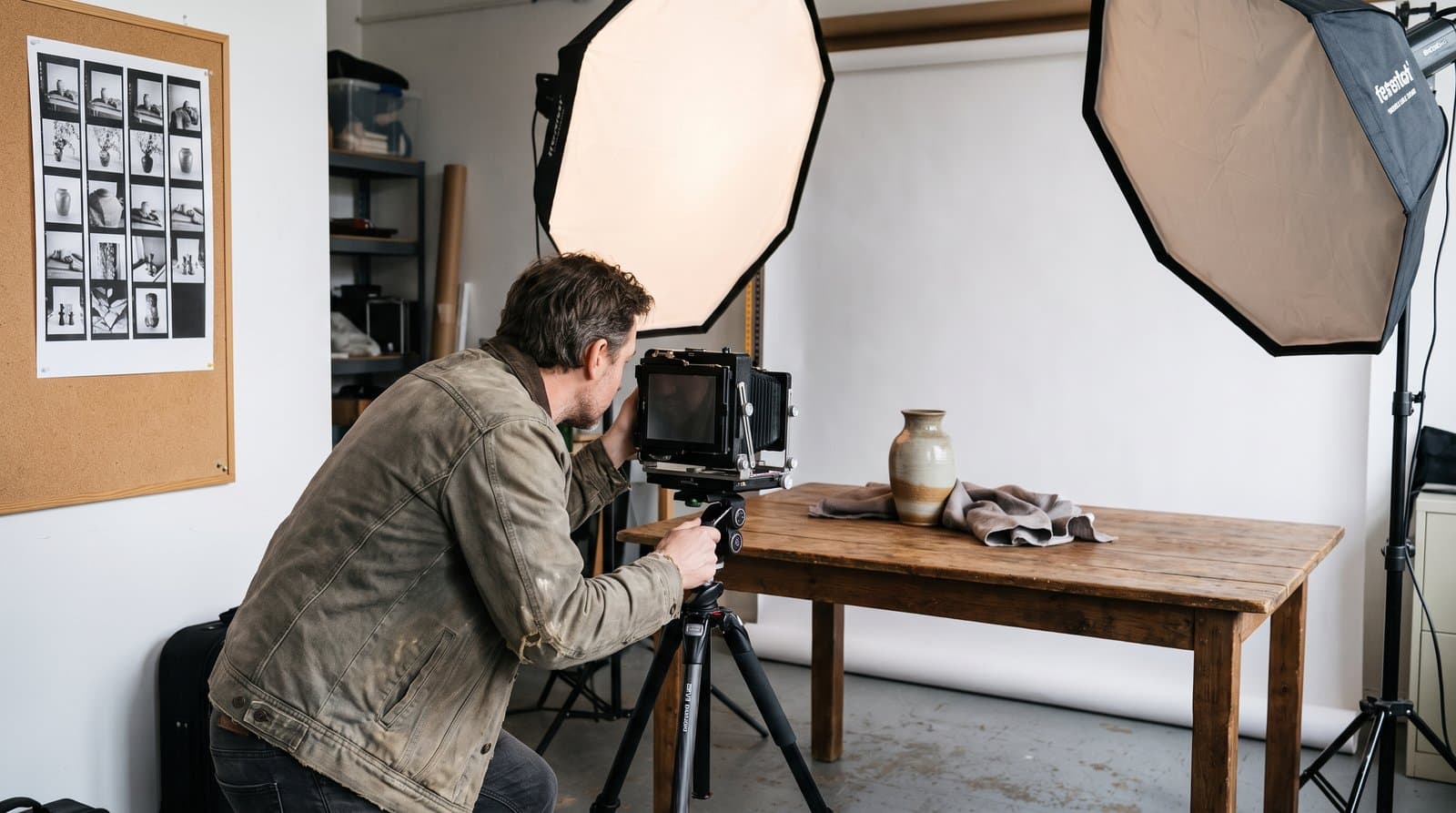
Cinema Studio in image mode is Higgsfield's most professional feature, and it adds real optical physics on top of the angle you chose. You pick the camera body and the lens glass, including Anamorphic and Cooke looks. You set the focal length, from 8mm ultra-wide to 50mm natural perspective. You control the aperture for real depth of field, so the background blur is a physical decision, not a stylistic guess.
Two habits make it work. First, the Hero Frame First approach: Photography Mode lets you perfect the still before any video, so the frame that anchors a campaign is signed off as an image before a single second of motion is generated. That frame then drives the whole clip, which we walk through in AI video ads with Higgsfield, ElevenLabs and CapCut. Second, save your favourite setups as presets. A brand that always shoots its products at 50mm, front angle, shallow depth of field, gets instant consistency across every generation because the preset carries it.
Where this is taught
The camera angles system and Cinema Studio are part of week 2 of the AI Marketing Professional Certificate, where we prompt each angle live on the demo brand's character so you can see the message change while the subject stays the same.
Frequently asked questions
Do I have to write the full prompt language or is the angle name enough? Use the full language. "Low angle" is ambiguous to a model; "camera below the subject looking upward, subject appears dominant and powerful, strong upward perspective" is not. The longer phrasing is what makes the angle reliable across generations.
Which angle should I default to if I am not sure? Eye level, medium shot. It is the conversational standard and the most trustworthy framing, and it is the hardest to get wrong. Change it only when you have a reason: authority (low angle), proof (extreme close-up), scale (long shot).
Can I change the angle after the image is generated? Yes. Higgsfield's Angles tool regenerates the same subject from a new viewpoint, and the Apps section (Shots and Angles) builds more images of a locked character from new angles. That is how you turn one hero image into a set.
Does the angle matter for video too? It matters more. The still you perfect in Photography Mode becomes the start frame of the video, so the angle you choose for the hero frame is the angle the whole clip inherits.

Written by
Omar Kandil
Founder and CEO, Talentdu · CEO, OBCIDO Inc. New York · Amazon best-selling author
Omar teaches the PDMA and AIMP programs live and runs OBCIDO Inc., a New York based marketing agency. Everything on this blog is drawn from work with real clients.