Keyword Research for Beginners: Volume, Difficulty, Intent and How to Pick Your First 10 Keywords
Keyword research for beginners with Semrush or Ubersuggest: start from a seed keyword, read volume, difficulty and intent, and pick your first 10 targets.

· 6 min read

In this article
- Key takeaways
- Start with a seed keyword
- The four things to read for every keyword
- Why a new site should target low-difficulty keywords
- Long-tail vs short-tail: where the easy wins are
- A worked example: wedding photography Beirut
- How to pick your first 10 keywords
- Where this is taught
- Frequently asked questions
Most new websites write about what the owner wants to say, not what anyone is searching for. Then they wonder why six months of blog posts brought no traffic. Keyword research fixes that in an afternoon: you find the exact phrases people type, see which ones you can realistically rank for, and build pages around them. Here is the method we teach, with Semrush or Ubersuggest, and a worked example for a wedding photographer in Beirut.
Key takeaways
- Start with one seed keyword in the words a customer would use, and let the tool expand it into hundreds of related phrases.
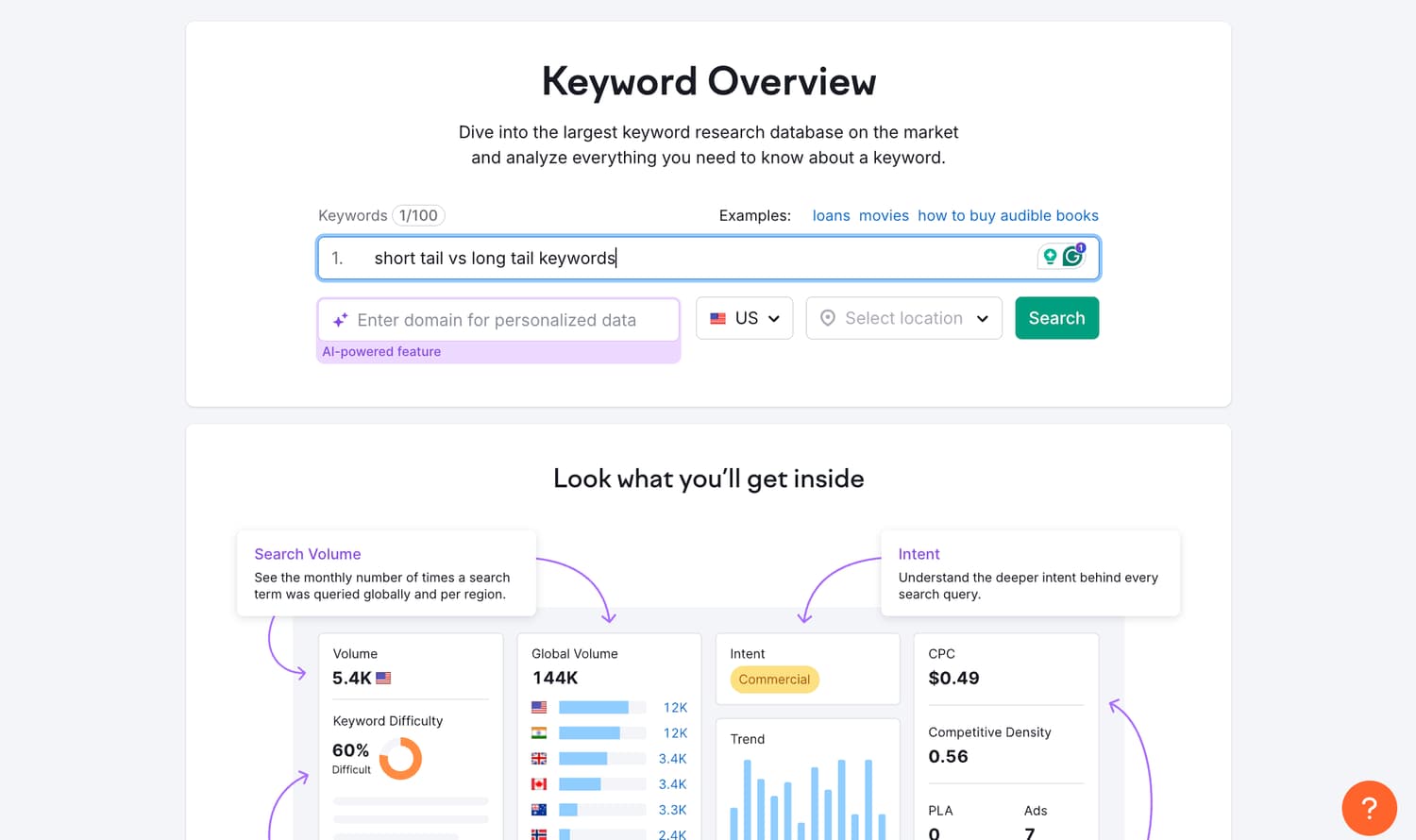
- For every keyword read four things: monthly search volume, keyword difficulty, search intent and the related questions people ask.
- A new site should target low-difficulty keywords first. Competing for high-difficulty terms with a new domain is a losing battle.
- Long-tail phrases have less volume but far less competition and clearer intent, which makes them the right first targets.
- Pick 5 to 10 keywords, one per page, and write for those before you chase anything bigger.
Start with a seed keyword
Keyword research starts with a seed keyword: a short phrase that describes what you sell, written the way a customer would search for it. "Wedding photography Beirut", "physiotherapy Dubai", "specialty coffee Riyadh". Enter it into Semrush or Ubersuggest and the tool returns a list of related keywords, each with data attached.
Both tools work the same way for this exercise: seed keyword in, keyword list out, then filter. Semrush has the deepest data; Ubersuggest is simpler and enough for a small business. Both change their plans regularly, so check the pricing page before you commit.
The four things to read for every keyword
For each keyword, read the volume, the difficulty, the intent and the related questions, in that order. Together they tell you whether a keyword is worth a page.
| What to read | What it tells you | How to use it |
|---|---|---|
| Search volume | Average monthly searches for the exact phrase | Ignore anything with zero; do not be seduced by the biggest numbers |
| Keyword difficulty (KD%) | How hard it is to rank on page one, based on the sites already there | New sites: filter for low difficulty first |
| Search intent | Whether the searcher wants to learn (informational) or buy (transactional), sometimes navigate or compare | Match the page type: article for informational, service page for transactional |
| Related keywords and questions | Variations and the questions people ask around the topic | These become your long-tail targets and your subheadings |
Intent is the one beginners skip, and it decides whether a ranking earns you money. "How much does a wedding photographer cost" is informational; the right page is an honest article. "Wedding photographer Beirut prices" is closer to transactional; the right page is your packages page. Write the wrong page type and you may rank and still get nothing.
Why a new site should target low-difficulty keywords
A new domain should target low-difficulty keywords because the sites already ranking for high-difficulty terms have years of content, backlinks and authority that a new site cannot match in months. Our rule in the program is blunt: competing for high-difficulty terms with a new domain is a losing battle. You will publish a good page and watch it sit on page four.
Low-difficulty keywords are the ones where page one is held by weak pages: thin directory listings, forum threads, outdated articles. A specific, well-written page from a small business can beat those, and each win builds the authority that eventually makes the hard phrase reachable.
Long-tail vs short-tail: where the easy wins are
Long-tail keywords, the longer and more specific phrases, are where a beginner wins, because they have lower difficulty and clearer intent than short head terms. "Photographer" is short-tail: huge volume, impossible difficulty, and no idea what the searcher wants. "Outdoor wedding photographer Batroun" is long-tail: small volume, low difficulty, and a searcher very close to booking.
The trade-off is volume. One long-tail keyword may bring a handful of visits a month, but those visits convert, and you can rank for dozens of them with dozens of specific pages. We cover the full comparison in Short vs. Long-Tail Keywords; the short version is that a new site builds its first ten targets almost entirely from the long tail.
A worked example: wedding photography Beirut
Take a wedding photographer launching a new site and type "wedding photography Beirut" as the seed keyword. The tool returns the seed plus related phrases such as "wedding photographer Lebanon", "wedding photography packages Beirut", "engagement photoshoot Beirut" and "how much does a wedding photographer cost in Lebanon".
Now apply the four readings and sort. A selection for a new site might look like this (the labels are illustrative; the tool gives you real figures for your market on the day you look):
| Keyword | Volume | Difficulty | Intent | Decision |
|---|---|---|---|---|
| wedding photographer Lebanon | High | High | Transactional | Later, once the site has authority |
| best wedding photographers in Lebanon | Medium | High | Commercial, comparison | Later |
| wedding photography packages Beirut | Low to medium | Low | Transactional | Target now: packages page |
| wedding photographer prices Lebanon | Low to medium | Low | Transactional | Target now: pricing section or FAQ |
| engagement photoshoot Beirut | Low | Low | Transactional | Target now: service page |
| destination wedding photographer Lebanon | Low | Low to medium | Transactional | Target now: dedicated page |
| how much does a wedding photographer cost in Lebanon | Low | Low | Informational | Target now: blog article |
| outdoor wedding venues Lebanon photography | Low | Low | Informational | Target now: blog article with your own photos |
The pattern is the point. The two biggest keywords go on a "later" list. The first targets are specific, low-difficulty phrases, each mapped to a page type that matches its intent. Export the full list so you can return to it when the first ten are done.
How to pick your first 10 keywords
Choosing the first ten is a filtering process, not a judgement call. In the program we run it as a practical exercise:
- Enter your seed keyword and export the full related-keyword list.
- Delete anything with zero volume or with intent that does not fit your business (job seekers, DIY, other meanings).
- Sort by difficulty, lowest first, and keep the bottom third.
- Label each remaining keyword with its intent and the page type it needs: service page, article, FAQ, comparison.
- Pick 5 to 10 that cover different pages, so you are not writing ten articles competing for one phrase.
- Assign one primary keyword per page, and note two or three related questions to answer as subheadings.
That list is your content plan for the next quarter. When those pages are live, repeat the exercise with a slightly higher difficulty ceiling.
Where this is taught
Keyword research is a hands-on exercise in week 9 of the Professional Digital Marketing Associate Diploma: you run your own seed keyword through Semrush or Ubersuggest and leave with 5 to 10 target keywords for your project site.
Frequently asked questions
Is Ubersuggest good enough, or do I need Semrush? For a small business site, Ubersuggest gives you volume, difficulty, intent and related questions, which is everything this method needs. Semrush has deeper data and is what most agencies use. Start with whichever your budget allows and check current plans, since both change.
What counts as low keyword difficulty? There is no universal threshold, because each tool scores differently and each market is different. Sort your own list by difficulty and work from the bottom; the lowest third is where a new site starts.
How many keywords should one page target? One primary keyword per page, plus the related questions and variations that belong to the same topic. One page chasing several unrelated keywords usually ranks for none of them.
How often should I redo keyword research? Every quarter, or whenever you plan a new batch of pages. Volumes shift with the season, competitors publish, and your own site gains authority, which moves keywords from the "later" list into reach.

Written by
Omar Kandil
Founder and CEO, Talentdu · CEO, OBCIDO Inc. New York · Amazon best-selling author
Omar teaches the PDMA and AIMP programs live and runs OBCIDO Inc., a New York based marketing agency. Everything on this blog is drawn from work with real clients.