How to Start a Digital Marketing Career in Lebanon in 2026: A Step-by-Step Plan
A practical, step-by-step plan for starting a digital marketing career from Lebanon in 2026: the skills to learn first, how to build a portfolio without a job, where the work is, and how to get hired or land your first clients.

· Updated · 5 min read

In this article
- Key takeaways
- Step 1: Learn the fundamentals before any tool
- Step 2: Pick one small real business and become its marketer
- Step 3: Build a brand identity and a website
- Step 4: Set up one content system and run it for a month
- Step 5: Run one paid campaign with a small budget
- Step 6: Add AI to every step above
- Step 7: Package it and go to market
- Where the jobs are for Lebanese marketers
- Do you need a certificate?
- Frequently asked questions
Most people who ask me how to get into digital marketing are not short of motivation. They are short of a sequence. They open ten tabs, take three free courses at once, and six months later have a folder of certificates and no work to show. This is the sequence I give them, in the order that actually gets people hired or paid from Lebanon.
Key takeaways
- Learn in this order: fundamentals, one website, one content system, one paid channel, then AI on top. Not the other way around.
- Your portfolio is the product. Build it on a real business, even a tiny one, before you have a job.
- The work is remote and regional. Employers and clients in the Gulf hire from Lebanon every day; treat the whole region as your market from day one.
- Certificates get you past filters. Work samples get you the interview. You need both.
Step 1: Learn the fundamentals before any tool
Marketing tools change every quarter. Fundamentals do not. Before you touch an ad account, be able to explain in plain words: what a persona is, the difference between paid, owned and earned media, what a funnel is, and what CTR, CPC, CPA, ROAS and customer lifetime value mean. If those five metrics are not automatic, everything you build later will be guesswork.
Give this two weeks. Read, watch, and write a one-page summary in your own words. If you cannot explain it to a friend who runs a shop, you do not know it yet.
Step 2: Pick one small real business and become its marketer
The fastest way to learn is to have something at stake. Find one business you can help for free or for a token fee: a cousin's clinic, a friend's cafe, a neighbourhood gym, your own side project. You are looking for a place to practise, not a client to impress.
Everything in the next steps gets built for this business. That is how a portfolio appears without anyone hiring you.
Step 3: Build a brand identity and a website
Start with the basics of branding: what the business stands for, who it talks to, a colour palette, a typeface, and consistent social handles. Then build a service website or a landing page. Squarespace is enough for most service businesses; for a shop, Shopify. You will learn more about how the web works in one weekend of building than in a month of reading.
Deliverable for your portfolio: a live site you can send a link to.
Step 4: Set up one content system and run it for a month
Pick the platform where the business's customers actually are, usually Instagram in Lebanon, LinkedIn if the business sells to companies. Define three to five content pillars, plan a month of posts, design them in Canva, schedule them with a free tool, and publish on time for four weeks. Consistency for one month teaches you more than any course module on "social media strategy".
Deliverable: a month of published content and a short note on what performed.
Step 5: Run one paid campaign with a small budget
This is where most self-taught marketers stall, because it costs money. It does not have to cost much. A small daily budget on Meta for two weeks, with a clear objective, one audience, and two ad variations, will teach you the campaign, ad set and ad structure, how to read the dashboard, and how to make a decision from data. Write down what you changed and why.
Deliverable: a one-page campaign report with screenshots.
Step 6: Add AI to every step above
Only now do AI tools make sense, because you know what good output looks like. Use an AI assistant to draft copy you then edit, generate image variations for your posts, and build a simple automation such as a lead form that triggers a drafted reply. AI multiplies a marketer who understands the work. It does not replace the understanding.
Step 7: Package it and go to market
You now have a brand, a site, a month of content and a campaign report for a real business. Put them on a single page: a simple portfolio site with three case studies, each one problem, what you did, what happened. Update your LinkedIn headline to say what you do, not what you are looking for. Then apply, in this order: agencies in Beirut, remote roles with Gulf companies, and freelance platforms where your Arabic and English are an advantage.
Where the jobs are for Lebanese marketers
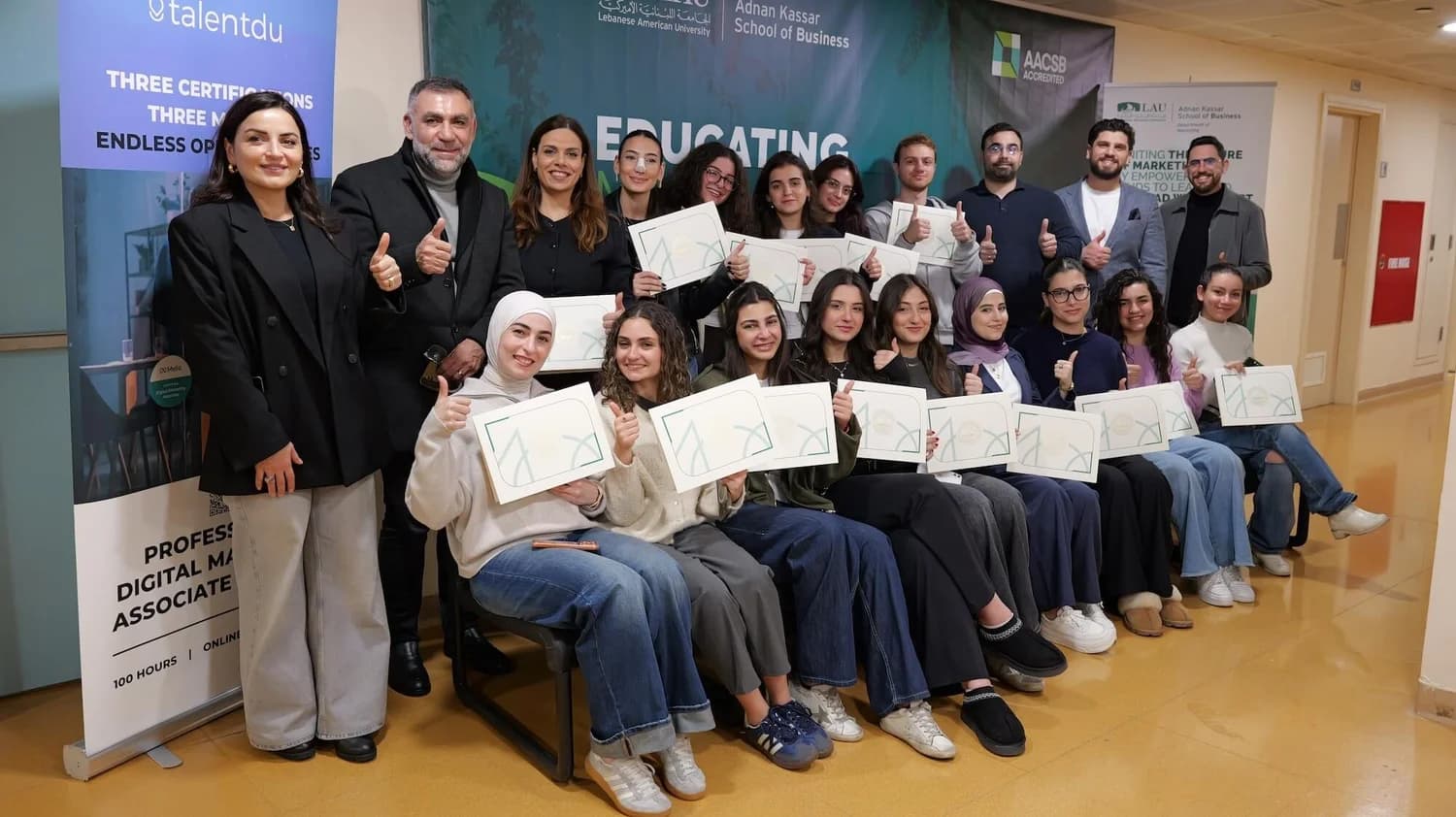
The Lebanese market is small, but Lebanese marketers work everywhere. Our graduates work at agencies and companies in Beirut, Dubai, Riyadh, Jeddah, Doha and beyond, both employed and freelance. The pattern that repeats: a strong portfolio plus a recognized credential gets a first remote contract, and the first contract gets the second.
Do you need a certificate?
You need both a portfolio and a credential, for different reasons. The portfolio proves you can do the work. The credential gets your CV through the filter that HR and recruiters apply before anyone looks at the portfolio. If you want a structured path that produces both at once, our Professional Digital Marketing Associate Diploma covers the steps above across twelve weeks, live, and graduates with credentials from LAU ACE, Google and Meta, with two CPD certificates included. The full curriculum is on the program page. If you prefer to self-teach, the seven steps above are the same path, just without the schedule and the feedback.
Frequently asked questions
How long does it take to become job-ready? Following the plan above with consistent effort, most people have a credible portfolio within three to four months. Getting hired depends on the market and how actively you apply.
Do I need a marketing degree? No. Many of our graduates came from hospitality, medicine, engineering and administration. Employers hire for demonstrated skills and results.
Should I specialize? Start broad so you understand how the channels fit together, then specialize where you enjoy the work and where the demand is: paid media, content, SEO or AI-assisted marketing.
Is English enough, or do I need Arabic? Both help. English is the working language of most regional agencies; Arabic content and audience understanding is an advantage that international candidates cannot offer.
Written by
Omar Kandil
Founder and CEO, Talentdu · CEO, OBCIDO Inc. New York · Amazon best-selling author
Omar teaches the PDMA and AIMP programs live and runs OBCIDO Inc., a New York based marketing agency. Everything on this blog is drawn from work with real clients.