The 5 Types of SEO Explained: On-Page, Off-Page, Technical, Local and Content
The five types of SEO in plain terms: how search engines crawl, index and rank, what each type covers, where a new site should start, and where GEO fits.

· 6 min read

In this article
Paid ads stop working the moment you stop paying. SEO keeps working. That difference is why every business owner eventually asks about it, and why so many give up after a month: "SEO" is not one job but five, and most people work on one and wonder why the others did not move. Here is the map we teach, from how a search engine works to where a new website in Beirut or Riyadh should begin.
Key takeaways
- Search engines do three things: crawl your pages, index them, and rank them. Your job is to make all three easy.
- The five types of SEO are on-page, off-page, technical, local and content. They overlap, but each has its own checklist and its own tools.
- A new site should start with technical basics, then on-page and content around low-difficulty keywords, then local SEO if it serves a physical area. Off-page comes last because it takes longest.
- Google and AI assistants hold your content to the same standard: E-E-A-T, meaning experience, expertise, authoritativeness and trustworthiness.
- Search is becoming "search everywhere": ranking on Google still matters, and being cited by ChatGPT, Claude and Gemini is the next layer, called GEO.
How search engines work: crawl, index, rank
A search engine finds your page, stores it, and then decides where it belongs in the results for a given question. Each step can fail silently.
- Crawling. Bots follow hyperlinks across the web and discover new pages. If nothing links to a page and it is not in your sitemap, it may never be found.
- Indexing. The page is analysed and stored in the search engine's database. Pages blocked by mistake, duplicated, or too slow to load can be crawled and still not indexed.
- Ranking. For each search, indexed pages are sorted by algorithms that weigh search intent and quality.
The ranking factors we teach are the stable ones: content quality and relevance, proper keyword usage, the number and quality of backlinks, page speed and mobile-friendliness, and user experience signals such as clicks, time on page and bounce rate. Each of the five types of SEO improves one or more of these.
The five types of SEO and what each covers
Each type of SEO targets a different part of the system: what is on the page, what other sites say about you, how the site is built, where you are located, and what you publish.
| Type | What it is | Key elements |
|---|---|---|
| On-page SEO | The content on your pages | Keywords in the SEO title, headings, meta description, alt text and URL slug; internal links |
| Off-page SEO | External signals about your site | Backlinks, PR mentions, social proof, brand mentions |
| Technical SEO | Site infrastructure | Speed, mobile-friendliness, crawlability, HTTPS, XML sitemap, schema markup |
| Local SEO | Location-based search | Google Business Profile, customer reviews, NAP consistency, local keywords, directories |
| Content SEO | Creating valuable content | Keyword targeting, search intent, content depth, structure, freshness |
On-page SEO
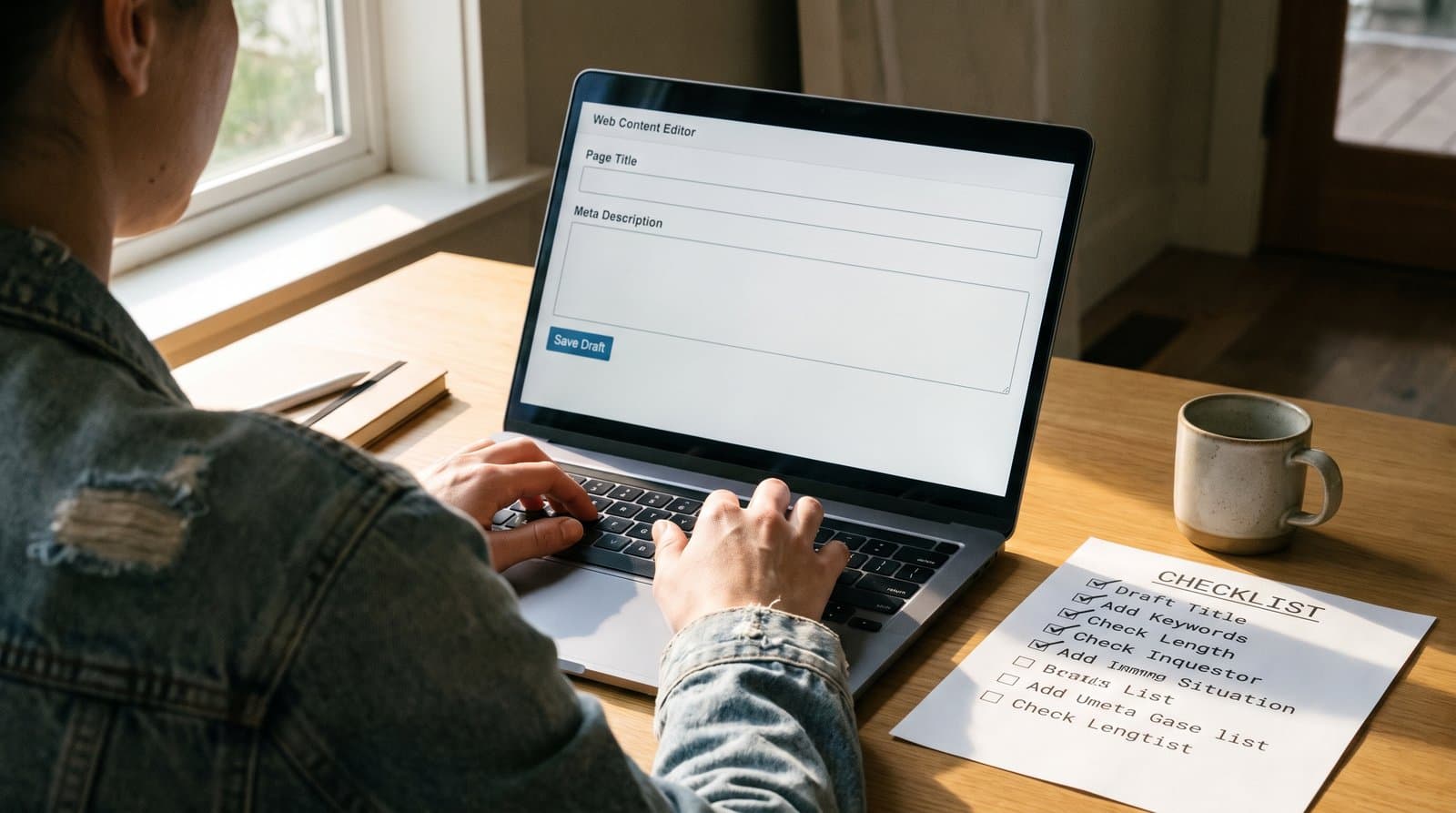
On-page SEO is everything you control inside a single page: an SEO title under 60 characters with the main keyword, a meta description under 160 characters, one H1 containing the keyword, H2 and H3 headings with related keywords, a short slug such as /interior-design-dubai, alt text on every image, and internal links. Write for humans first; keyword stuffing is penalised.
Off-page SEO
Off-page SEO is what the rest of the web says about you. Backlinks from relevant, trusted sites remain one of the strongest ranking factors, reinforced by PR mentions, reviews and brand mentions. It is the slowest type to build because you do not control it.
Technical SEO
Technical SEO makes the site easy to crawl and pleasant to use. Six checks cover most of it: mobile-friendly design, fast page speed (test with PageSpeed Insights), HTTPS, an XML sitemap submitted in Google Search Console, no broken links, and schema markup validated with Google's Rich Results Test.
Local SEO
Local SEO wins the searches with a place in them, or a place implied by the searcher's location. Claim and fully optimise your Google Business Profile, keep your name, address and phone identical everywhere online, encourage and answer reviews, target local keywords such as "best spa in Beirut" rather than "best spa", and get listed in directories your customers use.
Content SEO
Content SEO is the most important long-term strategy, because it is how a site earns rankings for questions it did not exist for yesterday. Target keywords people search, match the intent behind them (learn, buy or compare), cover topics thoroughly, structure with headings, short paragraphs and bullet points, add images and tables, link internally, and update time-sensitive posts.
Where a new small website should start
Start with the technical basics, then on-page and content around keywords you can actually win, then local SEO if you serve a physical area, and leave off-page for later.
- Fix the technical floor first. Run a free audit with a tool such as SEO Space, fix broken links and missing meta tags, confirm HTTPS and mobile display, and submit the sitemap in Search Console. This takes a day and removes the reasons pages never get indexed.
- Do keyword research before writing anything. Use Semrush or Ubersuggest with a seed keyword such as "wedding photography Beirut", and pick 5 to 10 targets. Our rule for new domains: start with low keyword difficulty terms. Competing for high-difficulty terms with a new site is a losing battle. The reasoning is in Short vs Long-Tail Keywords.
- Optimise the core pages, then publish content. Home, services and contact pages get the on-page checklist. Then one well-structured article per target keyword, written for the intent behind it.
- If you have a location, do local SEO the same week. For a clinic in Achrafieh or a cafe in Jumeirah, the Google Business Profile will bring customers before any article ranks.
- Earn off-page signals as a by-product. Partners, suppliers, press and directories link to businesses that publish useful things.
From SEO to GEO: the shift to "search everywhere"
SEO optimises for Google and Bing. GEO, Generative Engine Optimization, optimises for AI assistants such as Claude, ChatGPT and Gemini, which retrieve trusted sources, analyse them and generate an answer that cites a handful of brands. The two are converging into what we call search everywhere optimisation: showing up wherever the decision happens.
Four things change in emphasis: from keywords to entities and context, from ranking number one to relevance and trust, from content volume to validation and citations, and from Google alone to a multi-platform presence including YouTube, Reddit, LinkedIn and review sites.
Nothing you do in the five types above is wasted. Factual, well-structured, consistently branded content ranks on Google and gets cited by AI. The full playbook, with six strategies and the schema types to add, is in our GEO guide.
Where this is taught
The five types, the website audit, keyword research and the introduction to GEO are week 9 of the Professional Digital Marketing Associate Diploma, where each student audits their own project site, picks their target keywords and writes one optimised article.
Frequently asked questions
Which type of SEO is most important? Content SEO over the long term, because it compounds. In the short term, whichever type is currently broken: a slow, unindexed site needs technical work before content can rank, and a local business without a Google Business Profile is missing its biggest source of customers.
How long does SEO take to show results? Expect months rather than weeks for competitive terms, and faster movement on low-difficulty long-tail keywords and local searches. That lag is why we teach SEO alongside paid ads: ads bring customers while SEO builds the asset.
Do I still need SEO if people are using ChatGPT to search? Yes. AI assistants retrieve their answers from indexed, trusted web pages, so a site Google cannot crawl is invisible to them too. GEO adds a layer on top of SEO.
Can I do SEO myself or do I need an agency? The technical floor, on-page checklist, local profile and content can all be done by an owner or one marketer with free tools. Agencies add value on scale and off-page work.

Written by
Omar Kandil
Founder and CEO, Talentdu · CEO, OBCIDO Inc. New York · Amazon best-selling author
Omar teaches the PDMA and AIMP programs live and runs OBCIDO Inc., a New York based marketing agency. Everything on this blog is drawn from work with real clients.