6 Skills Every Digital Marketing Specialist Needs in 2026 (and How to Build Each One)
The six skills every digital marketing specialist needs in 2026, what each looks like on the job in Lebanon and the Gulf, and how to build them with real work.

· Updated · 8 min read

In this article
- Key takeaways
- 1. Content marketing: the foundation
- 2. Data and analytics: making decisions with numbers
- 3. Platform fluency and adaptability
- 4. AI proficiency: the skill that changed the other five
- 5. Basic design: creating visual impact
- 6. Paid advertising and ad creativity
- What this looks like in Lebanon and the Gulf
- How to build all six skills in 12 weeks
- Frequently asked questions
- Conclusion: your path to becoming a digital marketing specialist
A digital marketing specialist in 2026 needs six skills: content marketing, data and analytics, platform fluency, AI proficiency, basic design, and paid advertising. Those six show up in almost every job description I see from Beirut to Riyadh, and they are the six I built our PDMA program around. This guide explains what each skill looks like on the job, the tools you will be expected to know, and how to build it with real work rather than theory.
Key takeaways
- Employers hire for what you can show, not what you have studied. Every skill below ends with a project you can put in a portfolio.
- AI proficiency is now a core skill, not a bonus. It changes how the other five are done.
- The tools change; the skill is knowing which question each tool answers.
- You can build all six in about 12 weeks of structured practice. That is not a coincidence; it is how our program is timed.
1. Content marketing: the foundation
Content marketing is the ability to plan, write and publish content that brings the right people to a business and keeps them there. On the job it means blog posts, social captions, email sequences, video scripts and landing pages, all written for a specific audience and a specific goal.
In 2026 this skill has two halves. The first is still strategy: who is the reader, what do they search for, what should they do next. The second is working with AI assistants such as Claude and ChatGPT to draft and adapt faster, which only works if you can brief them properly and edit the output into something a human would want to read.
How to build it: write a content plan for a real business (a friend's shop, a family company), publish four pieces, and measure what happened. Our guide to content pillars shows how to plan a month in an afternoon.
2. Data and analytics: making decisions with numbers
Ads.google.com
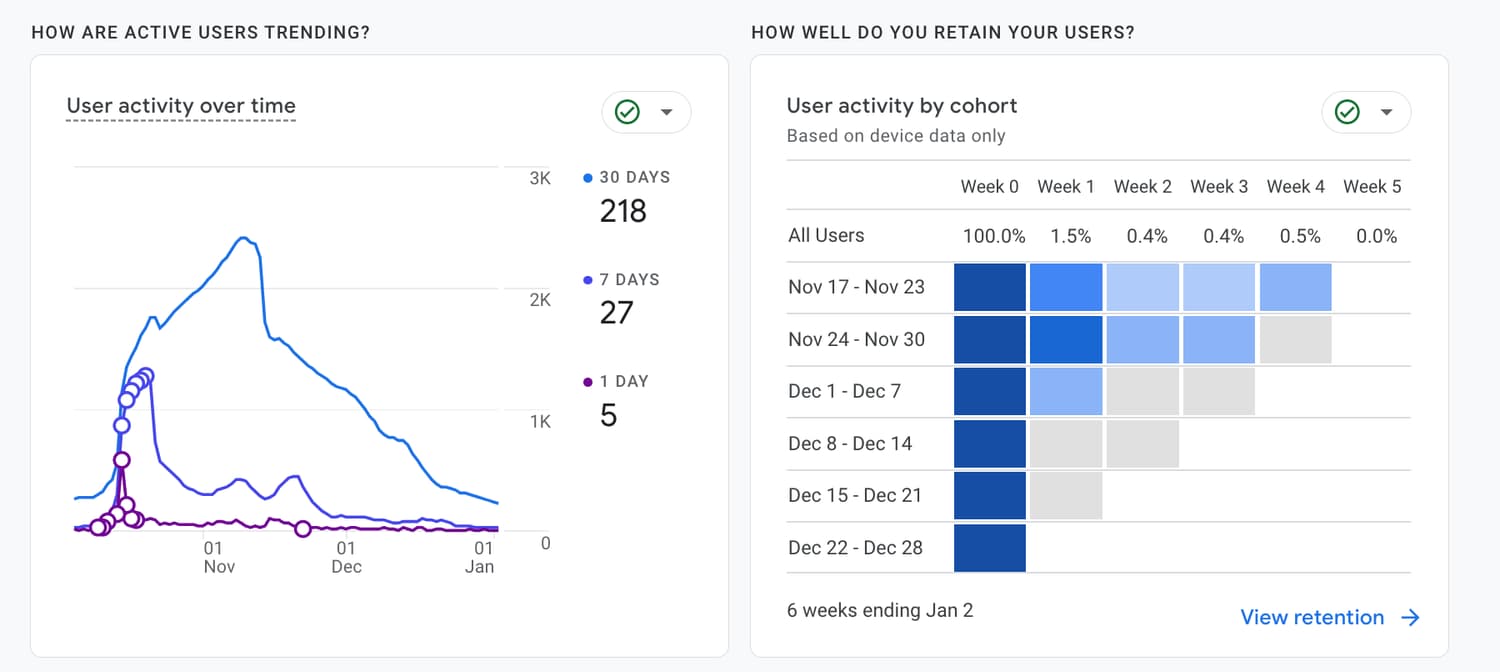
Data and analytics is the ability to read what happened and decide what to do next. The tools are Google Analytics 4, Google Search Console, Meta Ads Manager and Looker Studio, with Hotjar or Microsoft Clarity for how people behave on a page.
The skill is not the dashboard; it is the question. Which channel brought the customers who actually bought? Which ad creative has the lowest cost per lead? Which blog post ranks but does not convert, and why? A specialist who can answer those in a weekly report is worth more than one who can build a prettier chart.
How to build it: install GA4 on a real site, set up three conversion events, and write a one-page weekly report for four weeks. If CTR, CPC, CPA and ROAS are still fuzzy, start with digital marketing metrics explained.
3. Platform fluency and adaptability

Platforms change every quarter. The skill is being comfortable inside the tools the job uses today and able to learn the next one in a week. In 2026 that means Meta Business Suite, an SEO platform such as Semrush or Ahrefs, a scheduler such as Buffer, an email tool such as Mailchimp, a website builder such as Squarespace, WordPress or Shopify, and an automation tool such as Zapier.
Basic technical literacy helps: knowing what a pixel is, how a domain and a CMS work, how to install a tracking tag, how to build a simple page. You do not need to code. You need to not be afraid of settings.
How to build it: set up a small business's full stack from scratch: page, pixel, scheduler, email list, one Zap. Doing it once removes the fear permanently.
4. AI proficiency: the skill that changed the other five

AI proficiency is the ability to get reliable, on-brand results from AI tools and to know when not to use them. It is the fastest-growing requirement in marketing job descriptions in Lebanon and the Gulf, and it is the skill most candidates overstate.
In practice it means four things. Prompting properly (role, context, task, format) so the output is usable. Setting up reusable context in Claude Projects or ChatGPT Projects so you stop re-explaining the brand. Using AI creative tools such as Canva AI for design and Higgsfield for images and video. And building simple automations in Zapier with an AI step, for example a Zap that drafts a first reply to every new lead.
How to build it: take one recurring task (weekly report, caption writing, lead follow-up) and rebuild it with AI end to end. Then do a second one. Our guide to Claude Projects, Skills and Artifacts for marketers is the setup I use myself.
5. Basic design: creating visual impact
Canva.com
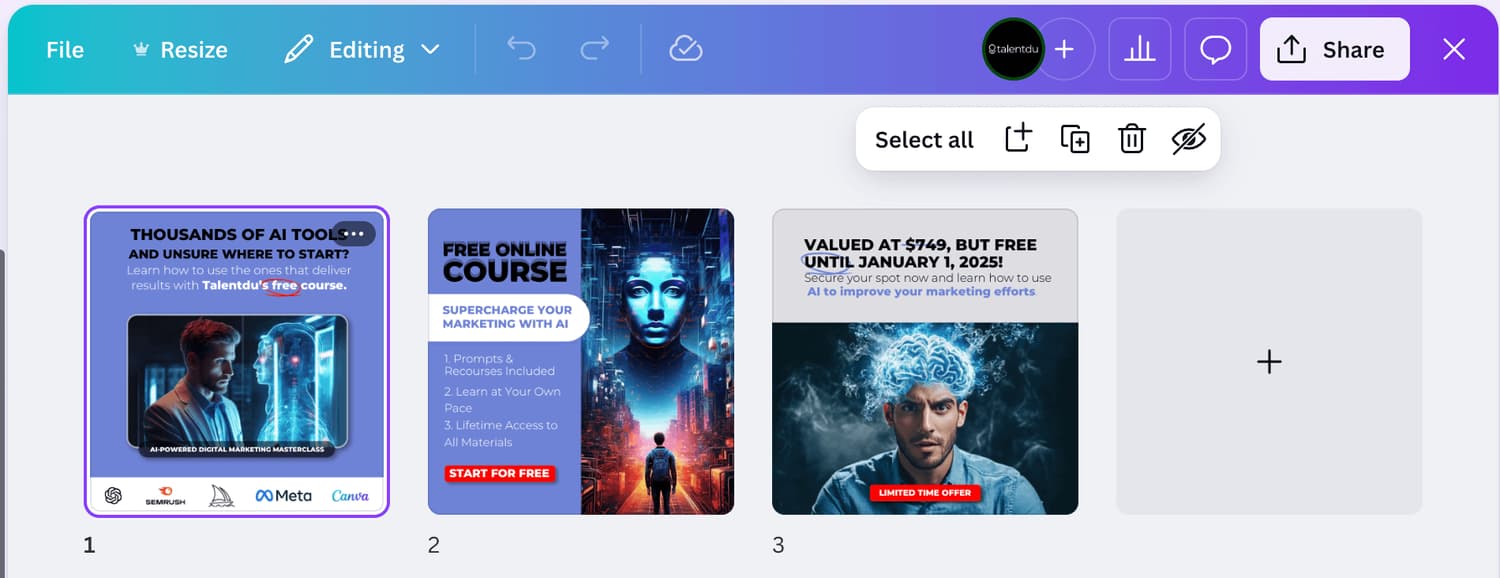
You do not need to be a designer, but you need to produce clean, on-brand visuals quickly and to know a bad one when you see it. The tools are Canva and Adobe Express; the knowledge is hierarchy, contrast, typography and layout, plus the right sizes for each placement.
A specialist who can turn a brief into a set of ad creatives in Canva by lunchtime, using the Brand Kit, is doing work that used to wait a week for a designer.
How to build it: recreate ten ads you admire in Canva, then design a full campaign (feed, story, reel cover, email header) for one brand with one Brand Kit.
6. Paid advertising and ad creativity
adsmanager.facebook.com
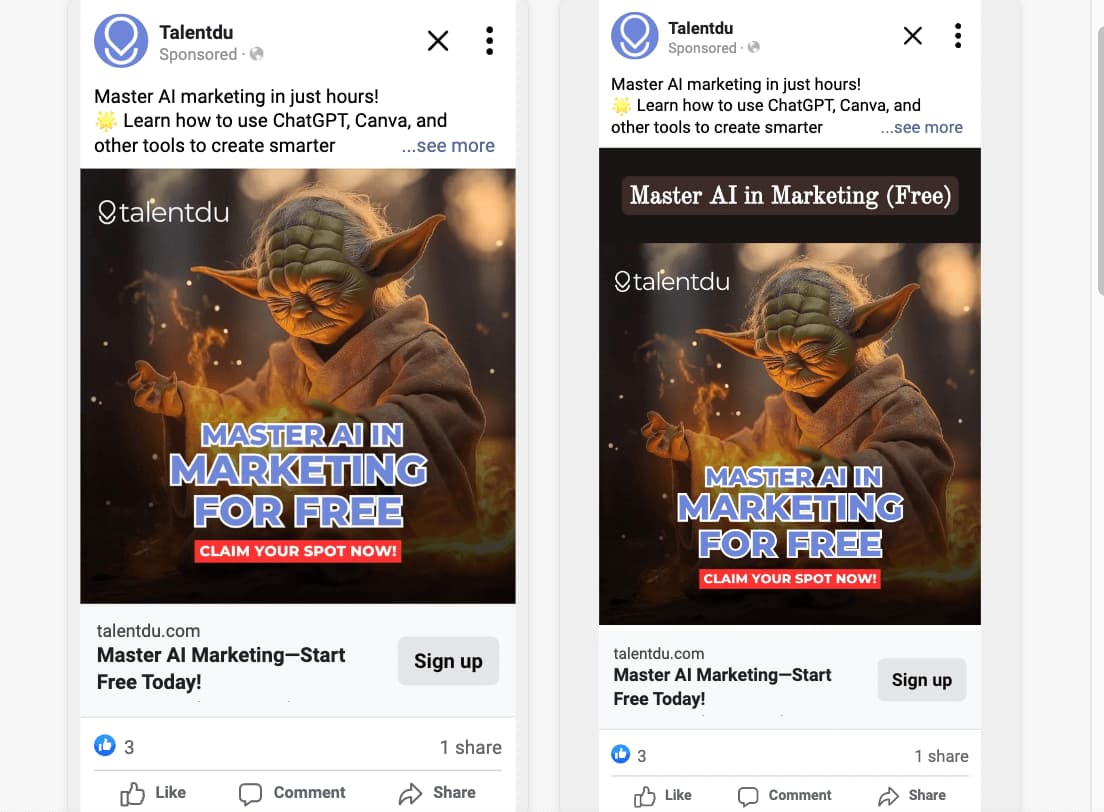
Paid advertising is the ability to launch, measure and improve campaigns on Meta Ads Manager, Google Ads, TikTok Ads and LinkedIn Ads, and to write and design creative that stops the scroll. Both halves matter: a perfect campaign structure with dull creative wastes budget, and great creative with the wrong objective wastes it faster.
In 2026 the mechanics are simpler than they were (Meta's Advantage+ handles much of the targeting), so the human edge is in the creative: hooks, angles, offers and the testing discipline to find the winner.
How to build it: run a real campaign with a small budget, even $50, for a real business, with three creatives and one clear conversion. Nothing in a course replaces watching your own cost per lead move.
What this looks like in Lebanon and the Gulf
The six skills are global; the job is local. In Lebanon and the Gulf, most roles expect you to work in Arabic and English, to run WhatsApp as the bottom of the funnel (click-to-chat ads, a reply script, a way to log leads), and to manage Instagram and TikTok as the main awareness channels. Salaries in Beirut are lower than in Dubai or Riyadh, but the same portfolio gets you interviews in both, and many of our graduates work remotely for Gulf companies from Lebanon. If that is your plan, read our step-by-step plan for starting a digital marketing career in Lebanon.
How to build all six skills in 12 weeks
- Weeks 1 to 3: strategy and content. Pick a real business, write the persona and content plan, publish four pieces.
- Weeks 4 to 6: analytics and platforms. Install GA4 and the Meta Pixel, set up conversions, write weekly reports.
- Weeks 7 to 9: paid ads and design. Build the creatives in Canva, run a small campaign, iterate.
- Weeks 10 to 12: AI and automation. Rebuild two recurring tasks with AI, build one Zap, assemble the portfolio.
Do this alone if you are disciplined. If you want an instructor, a cohort and recognised credentials at the end, our Professional Digital Marketing Associate Diploma (PDMA) with LAU ACE follows this arc over 12 weeks and 100 hours, and graduates leave with the Google Fundamentals of Digital Marketing and Meta Certified Digital Marketing Associate certifications alongside the LAU ACE diploma. To decide which certification matters for your market, see which digital marketing certification to get in 2026.
Frequently asked questions
What skills do you need to be a digital marketing specialist?
Content marketing, data and analytics, platform fluency, AI proficiency, basic design and paid advertising. Most job descriptions in 2026 list all six, and employers check them through a portfolio and a practical task rather than a degree.
Do I need a degree to become a digital marketing specialist?
No. A portfolio of real work, recognised certifications (Google, Meta, a university-backed diploma) and the ability to explain your results matter more than a degree in most hiring processes in Lebanon and the Gulf.
Which digital marketing skill is most in demand in 2026?
Paid advertising with strong creative, and AI proficiency. Employers want someone who can run Meta and Google campaigns profitably and who uses AI to produce more without dropping quality.
How long does it take to learn digital marketing?
About 12 weeks of structured practice to reach a hireable level across the six skills, then a year of real work to get good. Shorter courses can introduce concepts but rarely build the portfolio employers ask for.
What tools should a digital marketing specialist know?
Google Analytics 4, Google Search Console, Meta Business Suite and Ads Manager, Google Ads, one SEO platform (Semrush or Ahrefs), Canva, an email tool (Mailchimp), an AI assistant (Claude or ChatGPT) and Zapier.
Is digital marketing a good career in Lebanon and the Gulf?
Yes. Demand is strong across the region, the skills transfer between markets, and the work can be done remotely, which lets marketers in Lebanon serve clients and employers in the Gulf.
Conclusion: your path to becoming a digital marketing specialist

Six skills, one real business to practise on, twelve weeks of doing the work. That is the whole plan. The specialists who get hired are not the ones who read the most; they are the ones who can open a laptop in the interview and show a campaign, a report and a piece of content they made.
Looking for the best digital marketing course in Lebanon? Read our complete 2026 guide comparing every program available.

Written by
Founder and CEO, Talentdu
Omar teaches the PDMA and AIMP programs live and runs OBCIDO Inc., a New York based marketing agency. TEDx speaker and bestselling marketing author. Everything he writes here is drawn from work with real clients.